

Your Hands Are Your Persuasion Tool A Simple Move That Makes You Sound Clear and Convincing


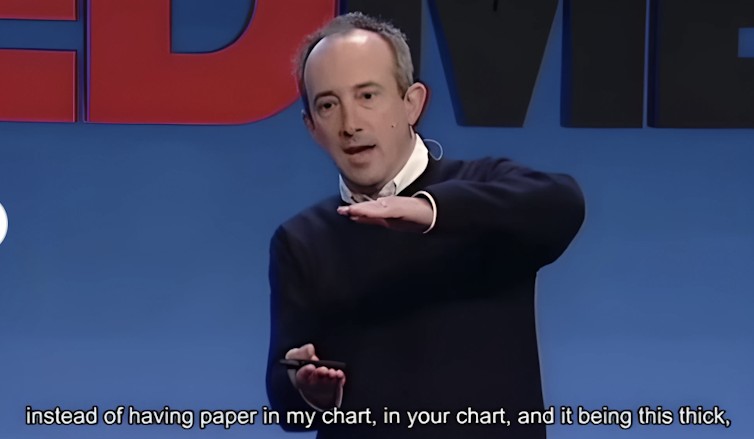
This is the key finding from my new research published in the Journal of Marketing Research, where I analyzed thousands of TED Talks and ran controlled experiments to examine how gestures shape communication. Whether you're giving a presentation, pitching an idea or leading a meeting, you probably spend most of your prep time thinking about what you'll say. But what about the ways you'll move your hands? Related: Your IQ May Affect How Well You Can Hear Speech, Study Shows I grew up in Italy, where gesturing is practically a second language. Now that I live in the United States, I've become acutely aware of how cultures differ in how, and how much, people move their hands when they talk. Still, across contexts and cultures, one thing is constant: People do talk with their hands. As someone who studies communication, I'd noticed how some speakers seemed instantly clearer when they gestured. This made me wonder: Do gestures actually make communicators more effective? The short answer is yes, but only when the gestures visually represent the idea you're talking about. Researchers call these movements \"illustrators.\" For example: To study gestures at scale, my team and I analyzed 200,000 video segments from more than 2,000 TED Talks using AI tools that can detect and classify hand gestures frame by frame. We paired this with controlled experiments in which our study participants evaluated entrepreneurs pitching a product. The same pattern of results appeared in both settings. In the AI-analyzed TED Talk data, illustrative gestures predicted higher audience evaluations, reflected in more than 33 million online \"likes\" of the videos. And in our experiments, 1,600 participants rated speakers who used illustrative gestures as more clear, competent and persuasive. What I found is that these gestures give listeners a visual shortcut to your meaning. They make abstract ideas feel more concrete, helping listeners build a mental picture of what you're saying. This makes the message feel easier to process – a phenomenon psychologists call \"processing fluency.\" And we found that when ideas feel easier to grasp, people tend to see the speaker as more competent and persuasive. But not all gestures help. Movements that don't match the message – like random waving, fidgeting or pointing to things in the space – offer no such benefit. In some cases, they can even distract. A practical takeaway: Focus on clarity over choreography. Think about where your hands naturally illustrate what you're saying – emphasizing size, direction or emotion – and let them move with purpose. Your hands aren't just accessories to your words. They can be a powerful tool to make your ideas resonate. I'm now investigating whether people can learn to gesture better – almost like developing a nonverbal vocabulary. Early pilot tests are promising: Even a 5-minute training session helps people become clearer and more effective through the use of appropriate hand gestures. Related: Our Brains Really Do 'Sync Up' When We Collaborate, Study Reveals While my research examined how individual gestures work together with spoken language, the next step is to understand what makes a communicator effective with their voice and, ultimately, across all the channels they use to communicate – how gestures combine with voice, facial expressions and body movement. I'm now exploring AI tools that track all these channels at once so I can identify the patterns, not just the isolated gestures, that make speakers more effective communicators. Giovanni Luca Cascio Rizzo, Assistant Professor of Marketing, University of Southern California This article is republished from The Conversation under a Creative Commons license. Read the original article.

Illustrators Make Ideas Clearer More Competent and More Persuasive
To study gestures at scale, my team and I analyzed 200,000 video segments from more than 2,000 TED Talks using AI tools that can detect and classify hand gestures frame by frame. We paired this with controlled experiments in which our study participants evaluated entrepreneurs pitching a product. The same pattern of results appeared in both settings. In the AI-analyzed TED Talk data, illustrative gestures predicted higher audience evaluations, reflected in more than 33 million online \"likes\" of the videos. And in our experiments, 1,600 participants rated speakers who used illustrative gestures as more clear, competent and persuasive. This section emphasizes the scale and quantitative results. What I found is that these gestures give listeners a visual shortcut to your meaning. They make abstract ideas feel more concrete, helping listeners build a mental picture of what you're saying. This makes the message feel easier to process – a phenomenon psychologists call \"processing fluency.\" And we found that when ideas feel easier to grasp, people tend to see the speaker as more competent and persuasive. But not all gestures help. Movements that don't match the message – like random waving, fidgeting or pointing to things in the space – offer no such benefit. In some cases, they can even distract. A practical takeaway: Focus on clarity over choreography. Think about where your hands naturally illustrate what you're saying – emphasizing size, direction or emotion – and let them move with purpose. Your hands aren't just accessories to your words. They can be a powerful tool to make your ideas resonate. I'm now investigating whether people can learn to gesture better – almost like developing a nonverbal vocabulary. Early pilot tests are promising: Even a 5-minute training session helps people become clearer and more effective through the use of appropriate hand gestures. Related: Our Brains Really Do 'Sync Up' When We Collaborate, Study Reveals While my research examined how individual gestures work together with spoken language, the next step is to understand what makes a communicator effective with their voice and, ultimately, across all the channels they use to communicate – how gestures combine with voice, facial expressions and body movement. I'm now exploring AI tools that track all these channels at once so I can identify the patterns, not just the isolated gestures, that make speakers more effective communicators. Giovanni Luca Cascio Rizzo, Assistant Professor of Marketing, University of Southern California This article is republished from The Conversation under a Creative Commons license. Read the original article.

Practical Takeaways and Future Research
A practical takeaway: Focus on clarity over choreography. Your hands aren't just accessories to your words. They can be a powerful tool to make your ideas resonate. I'm now investigating whether people can learn to gesture better – almost like developing a nonverbal vocabulary. Early pilot tests are promising: Even a 5-minute training session helps people become clearer and more effective through the use of appropriate hand gestures. While my research examined how individual gestures work together with spoken language, the next step is to understand what makes a communicator effective with their voice and, ultimately, across all the channels they use to communicate – how gestures combine with voice, facial expressions and body movement. I'm now exploring AI tools that track all these channels at once so I can identify the patterns, not just the isolated gestures, that make speakers more effective communicators. Giovanni Luca Cascio Rizzo, Assistant Professor of Marketing, University of Southern California This article is republished from The Conversation under a Creative Commons license. Read the original article.