


We come in peace—our first contact with aliens will look nothing like the movies


As astronomers scour the universe for traces of alien life, one researcher has revealed exactly what first contact will look like. However, that meeting won't look like the close encounters of a Hollywood blockbuster. According to the 'Eschatian Hypothesis', the first extraterrestrial civilisation we encounter is likely to be in its final moments of total collapse. This is because, just like dying stars and supernovae, civilisations are likely to burn their brightest just before they vanish into darkness. According to Dr David Kipping, of Columbia University, this theory means the first aliens are likely to be 'unusually loud'.
In This Article:
The Eschatian Hypothesis: first contact will be with a civilisation in its death throes
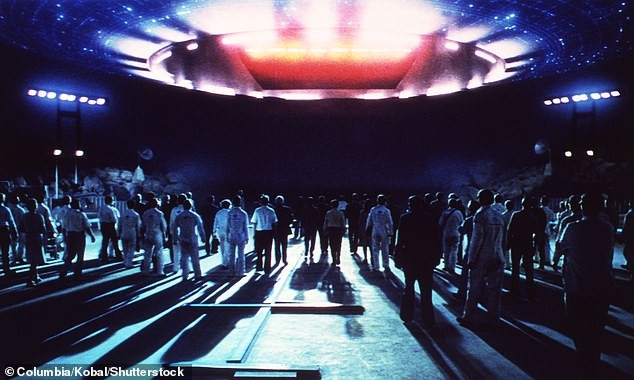
In a YouTube video, Dr Kipping says: 'Hollywood has preconditioned us to expect one of two types of alien contact, either a hostile invasion force or a benevolent species bestowing wisdom to humanity. But the Eschatian hypothesis is neither. Here, first contact is with a civilisation in its death throes, one that is violently flailing before the end.' A scientist has revealed what our first encounter with aliens will be like, and it won't look anything like what we have seen in movies like Close Encounters of the Third Kind (pictured) In a new paper, due to appear in Monthly Notices of the Royal Astronomical Society, Dr Kipping argues that finding aliens should follow the same rules as all other astronomical discoveries. Do YOU believe in aliens? That means the first examples we discover are not typical of their class, but rather 'rare, extreme cases'.
Understanding detection bias: why the first aliens may be unusually loud
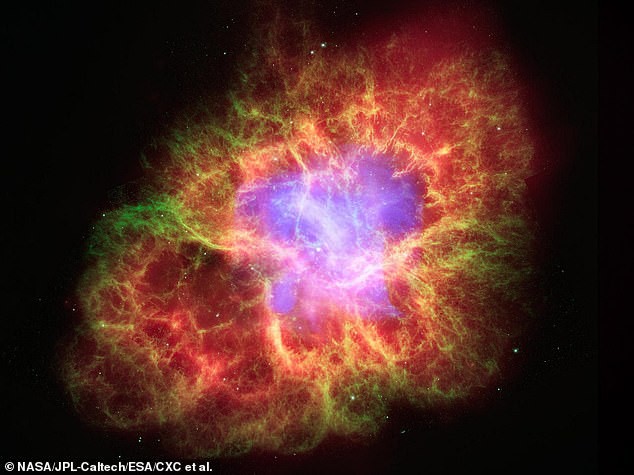
To understand how this 'detection bias' works, imagine looking up at the night sky on a clear night. Of the thousands of stars you can see, about a third will be giant, dying stars in the final stages of their lives. This transitory period lasts less than 10 percent of a star's lifetime, and only about one percent of stars in the universe are in this giant phase. However, since dying stars are so much brighter than their typical neighbours, they make up a huge proportion of the stars we can detect with the naked eye. The same is even true of more extreme events such as supernovae - the vast explosions which occur when massive stars run out of fuel and collapse. These explosions are staggeringly rare, with a Milky Way-sized galaxy only experiencing one every 50 years. The supernovae from dying stars (pictured) are incredibly rare, but we see thousands every year because they are so bright. In a sense, scientists say that alien civilisations should be the same, in that we are more likely to find one burning brightly in its final moments - even if these are rarer.
From bright dying stars to loud alien signals
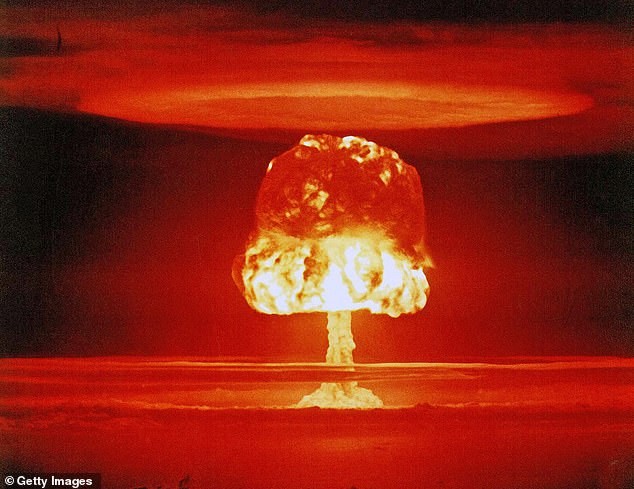
A nuclear war would produce a huge burst of energy that intelligent civilisations would be able to detect. Pictured: The Castle Union Nuclear Test, 1954. However, astronomers routinely discover thousands of supernovae every year, just because they are so incredibly bright. According to Dr Kipping, there's no reason that our first discovery of alien life shouldn't follow the exact same rules. 'So, by extension, we should expect that the first detection of an alien civilisation to be someone who is being unusually loud. Their behaviour will probably be atypical, but their enormous volume makes them the most likely candidate for discovery.' This means the first aliens we meet will be like a loud, obnoxious party guest - most people in the room don't act like that, but the ones that do get noticed by everyone. However, when we consider what could cause a civilisation to become loud, the situation becomes a lot more bleak. As civilisations become more advanced, they become more efficient - wasting less energy and using the energy they do have more sustainably. Just like how a well-maintained modern house leaks less heat than an old, crumbling home, healthy civilisations shouldn't be giving off huge amounts of excess energy. If humanity's first alien encounter is with a dying civilization, how should we respond? This means our first encounter with aliens won't be a purposeful communication, like in the new film Disclosure Day. Instead, we are more likely to hear a civilisation's last desperate shouts In this sense, the volume of a civilisation is a sign of 'extreme disequilibrium' that heralds impending collapse. For example, the intense heat and energy released by a nuclear war would cause a planet to light up in a way that sensitive telescopes could detect. Likewise, some scientists have suggested that aliens could even use rapid human-caused climate change as a sign of intelligent life on our planet. Some civilisations in total free-fall may even begin broadcasting signals into space in an attempt to reach other life. Dr Kipping has suggested that the famous 'Wow! Signal', detected by scientists in 1977, could have been a civilisation broadcasting one last desperate shout. Instead of doing deep studies of promising star systems or patiently waiting for a coherent message, Dr Kipping says scientists should frequently scan the entire sky. Brief unexplained signals, sudden flashes, or systems undergoing rapid, anomalous changes could all be signs of a loud civilisation going through collapse. So, while it might not be a cheering thought, this theory could help find our first signs of life out amongst the stars.
The Fermi Paradox and the Great Filter
The Fermi Paradox questions why, given the estimated 200-400 billion stars and at least 100 billion planets in our galaxy, there have been no signs of alien life. The contradiction is named after its creator, Italian physicist Enrico Fermi. He first posed the question back in 1950. Fermi believed it was too extraordinary that a single extra-terrestrial signal or engineering project has yet to be detected in the universe — despite its immense vastness. Fermi concluded there must a barrier that limits the rise of intelligent, self-aware, technologically advanced space-colonising civilisations. This barrier is sometimes referred to as the 'Great Filter'. Italian physicist Enrico Fermi devised the so-called Fermi Paradox in the 1950s, which explores why there is no sign of alien life, despite the 100 billion planets in our galaxy If the main obstacle preventing the colonisation of other planets is not in our past, then the barrier that will stop humanity's prospects of reaching other worlds must lie in our future, scientists have theorised. Professor Brian Cox believes the advances in science and engineering required by a civilisation to start conquering the stars will ultimately lead to its destruction. 'One solution to the Fermi Paradox is that it is not possible to run a world that has the power to destroy itself. It may be that the growth of science and engineering inevitably outstrips the development of political expertise, leading to disaster.' Other possible explanations for the Fermi Paradox include that intelligent alien species are out there, but lack the necessary technology to communicate with Earth. Some believe that the distances between intelligent civilisations are too great to allow any kind of two-way communication. If two worlds are separated by several thousand light years, it's possible that one or both civilisations would become extinct before a dialogue can be established. The so-called Zoo hypothesis claims intelligent alien life is out there, but deliberately avoids any contact with life on Earth to allow its natural evolution.