


Uranus Might Be Rockier Than It Appears and Not an Ice Giant


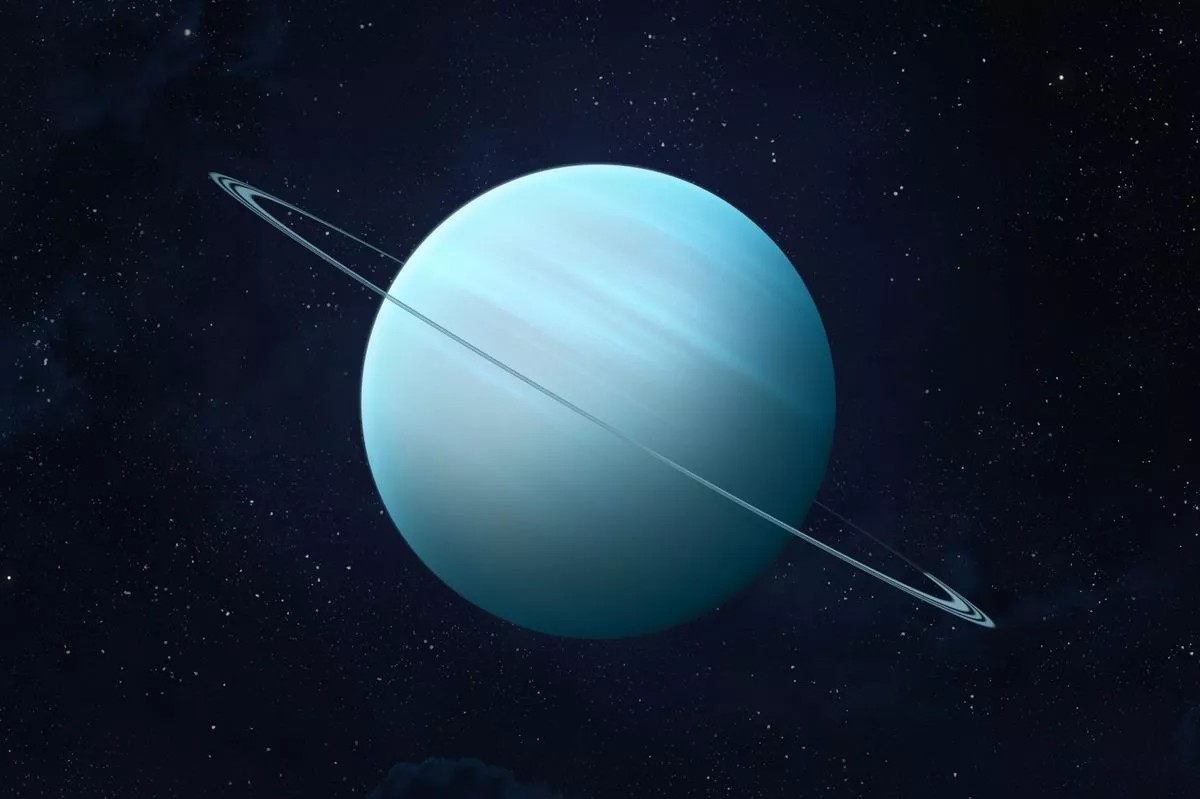
Uranus and Neptune might not be as icy as scientists reckon and could actually be far more rocky, new research claims. Scientists are probing decades of claims about our Solar System’s two most distant major planets. The duo have for a long, long time been seen as “ice giants” and different from “gas giants” Jupiter and Saturn. But the new study claims both planets could contain far more rocks and much less ice than previously thought.
In This Article:
Interior models merge physics and empirical data to explore rocky or water-rich interiors
Lead author Luca Morf, from the University of Zurich, Switzerland, said: “The ice giant classification is oversimplified as Uranus and Neptune are still poorly understood." aliens will 'reveal themselves to humanity' at the World Cup and 'fulfil prophecy' “Models based on physics were too assumption-heavy, while empirical models are too simplistic. We combined both approaches to get interior models that are both ‘agnostic’ or unbiased and yet, are physically consistent.” The team probed Uranus and Neptune by calculating the gravitational field that best matches data about their interior. Their results showed the pair could be either water-rich or more rocky. Put your skills to the test. And the study may also explain the mystery around the two planets’ strange magnetic fields.
Magnetic fields explained by ionic water layers
Ravit Helled, a professor at the University of Zurich, said: “Our models have so-called ‘ionic water’ layers which generate magnetic dynamos in locations that explain the observed non-dipolar magnetic fields. We also found that Uranus’ magnetic field originates deeper than Neptune’s.” The expert added: “Both Uranus and Neptune could be rock giants or ice giants depending on the model assumptions. Current data are currently insufficient to distinguish the two, and we therefore need dedicated missions to Uranus and Neptune that can reveal their true nature.”
Rocky or ice giant? Pluto’s surprise and the call for missions to Uranus and Neptune
The findings match previous studies which said Pluto, once thought to be ice-heavy, is actually dominated by rock. But the researchers admit they are still bamboozled by how materials behave under the extreme pressures and temperatures found deep inside planets. Morf added: “One of the main issues is that physicists still barely understand how materials behave under the exotic conditions of pressure and temperature found at the heart of a planet, this could impact our results.” For the latest breaking news and stories from across the globe from the Daily Star, sign up for our newsletters.