


UN to Watch Interstellar Comet 3I/ATLAS as It Zips Through Our Solar System in a Two Month Global Observing Campaign


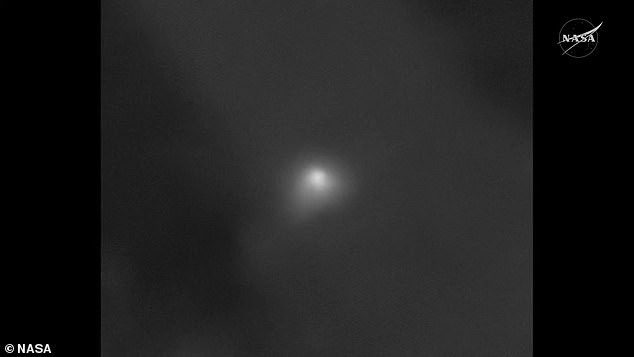
The United Nations (UN) has confirmed that Earth's planetary defenses will be observing the interstellar comet 3I/ATLAS as it races through our solar system. Starting on November 27, a global team of scientists with the International Asteroid Warning Network (IAWN) will kick off a two-month campaign to track the comet as it nears our planet. "While it poses no threat, comet 3I/ATLAS presents a great opportunity for the IAWN community to perform an observing exercise due to its prolonged observability from Earth and high interest to the scientific community," the UN explains on its website. "This 3I/ATLAS campaign is the 8th IAWN observing exercise since 2017 – IAWN holds these exercises roughly once a year." While 3I/ATLAS was only discovered in July 2025, the UN explained that this 'comet campaign' has long been planned. "IAWN had been planning to do a Fall 2025 comet campaign since 2024 to exercise capabilities for measuring the position of comets, which pose additional astrometric challenges as they appear as fuzzy extended objects compared to point–like asteroids in a telescope's field of view," it added. The news comes shortly after NASA put claims that the object could be an alien spacecraft to bed once and for all. "We want very much to find signs of life in the universe... but 3I/ATLAS is a comet," said Amit Kshatriya, a senior NASA official, at a press conference. Stargazers recently captured brand new clear images of the interstellar object 3I/ATLAS using lower quality telescopes compared to those used by NASA NASA's sophisticated HiRISE camera was supposed to provide a detailed image of the interstellar object near Mars, but the photo shown on Wednesday was blurry and vague Since it was first spotted in July, the object – dubbed 3I/ATLAS – has captivated scientists and internet users alike, even prompting Kim Kardashian to ask NASA for answers. Many scientists maintained it was merely a comet visiting us from a different solar system. However, others – including a member of US Congress and a Harvard researcher – were convinced that the object was an alien spacecraft. Last week, NASA released photos snapped by three of its Mars spacecraft as they passed just 18 million miles away from the object. These pictures finally put any speculation to rest, as they confirmed the object's identity. And unfortunately for alien hunters, the US space agency says that 3I/ATLAS is a comet. The one man holding on to hope that the object could be extraterrestrial is Harvard professor Avi Loeb, who has shared new amateur telescope images of the interstellar object, captured between November 22 and November 24. The photos reveal a glowing, fuzzy 'head' called a coma, along with a narrow tail stretching over 600,000 miles and pointing toward the sun instead of away from it like a typical comet. Recent telescope images have produced clearer views of the object than the photos shared by NASA on November 19 NASA maintained that 3I/ATLAS was a comet with no signs of extraterrestrial life One appears to reveal the shape of 3I/ATLAS, showing a cone–like object covered in a bright haze. The images came from everyday skywatchers using small backyard telescopes around the world, including in Japan, Spain, and Chile. Professor Loeb noted that a clear shot of the object on November 22, which showed its bright green body and long 'anti–tail,' was taken by Mitsunori Tsumura using a common 20–inch backyard telescope used by stargazers worldwide. Another caught a sharp image of the interstellar visitor over Spain that same night using a 12.4–inch telescope - a very popular size used by hobbyists in their backyards. Perhaps the sharpest picture Professor Loeb highlighted came from Paul Craggs of Canada, who was able to capture a clear image of the comet's current shape while traveling over North America on November 21.
In This Article:
Campaign Details When Why and How IAWN Will Observe 3I/ATLAS
Starting on November 27, a global team of scientists with the International Asteroid Warning Network (IAWN) will kick off a two-month campaign to track the comet as it nears our planet. "We want very much to find signs of life in the universe... but 3I/ATLAS is a comet," said Amit Kshatriya, a senior NASA official, at a press conference. "IAWN had been planning to do a Fall 2025 comet campaign since 2024 to exercise capabilities for measuring the position of comets, which pose additional astrometric challenges as they appear as fuzzy extended objects compared to point–like asteroids in a telescope's field of view," it added. The news comes shortly after NASA put claims that the object could be an alien spacecraft to bed once and for all. IAWN explains that this campaign is part of an ongoing series of annual exercises to test measuring the position of comets, which pose astrometric challenges because they appear as fuzzy extended objects in a telescope's field of view. This Fall 2025 campaign had been planned well in advance as part of the IAWN observing program, intended to exercise capabilities for measuring the position of comets. The campaign marks the 8th IAWN observing exercise since 2017. '],
NASA Debunks Alien Theories as 3I/ATLAS Is Identified as a Comet
Last week, NASA released photos snapped by three of its Mars spacecraft as they passed just 29 million kilometers away from the object. These pictures finally put any speculation to rest, as they confirmed the object's identity. And unfortunately for alien hunters, the US space agency says that 3I/ATLAS is a comet. The news comes shortly after NASA put claims that the object could be an alien spacecraft to bed once and for all. The photos echoed the official line that 3I/ATLAS is a comet with no signs of extraterrestrial life. The object has been studied from multiple angles, but NASA has maintained that there are no indications of life. The images came from Mars orbiters and rovers as they tracked the interstellar visitor from a distance of about 29 million kilometers.
Avi Loeb Holds Onto Hope as Amateur Observers Record 3I/ATLAS
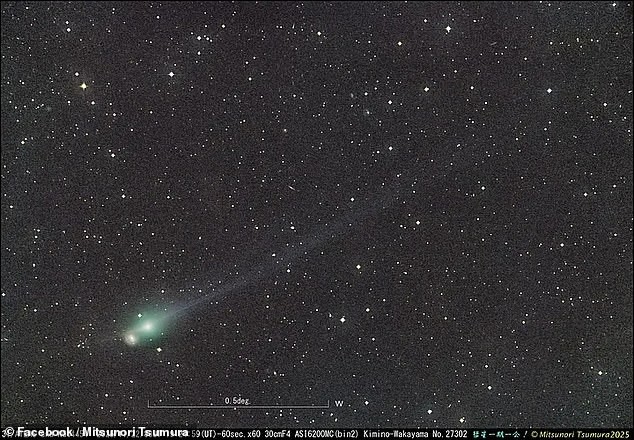
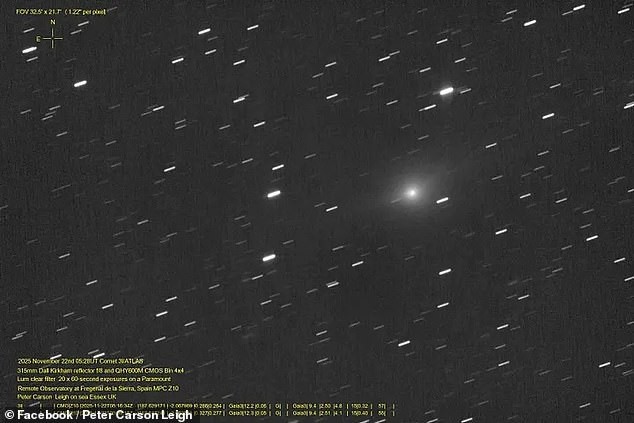
The one man holding on to hope that the object could be extraterrestrial is Harvard professor Avi Loeb, who has shared new amateur telescope images of the interstellar object, captured between November 22 and November 24. The photos reveal a glowing, fuzzy 'head' called a coma, along with a narrow tail stretching over 600,000 miles (about 966,000 kilometers) and pointing toward the sun instead of away from it like a typical comet. Recent telescope images have produced clearer views of the object than the photos shared by NASA on November 19. NASA maintained that 3I/ATLAS was a comet with no signs of extraterrestrial life. One appears to reveal the shape of 3I/ATLAS, showing a cone-like object covered in a bright haze. The images came from everyday skywatchers using small backyard telescopes around the world, including in Japan, Spain, and Chile. Professor Loeb noted that a clear shot of the object on November 22, which showed its bright green body and long anti-tail, was taken by Mitsunori Tsumura using a common 20-inch backyard telescope used by stargazers worldwide (about 50.8 cm). Another caught a sharp image of the interstellar visitor over Spain that same night using a 12.4-inch telescope (about 31.5 cm) – a very popular size used by hobbyists in their backyards. Perhaps the sharpest picture Professor Loeb highlighted came from Paul Craggs of Canada, who was able to capture a clear image of the comet's current shape while traveling over North America on November 21.