


Ukraine breakthrough as 'America ready to deploy troops to keep the peace'


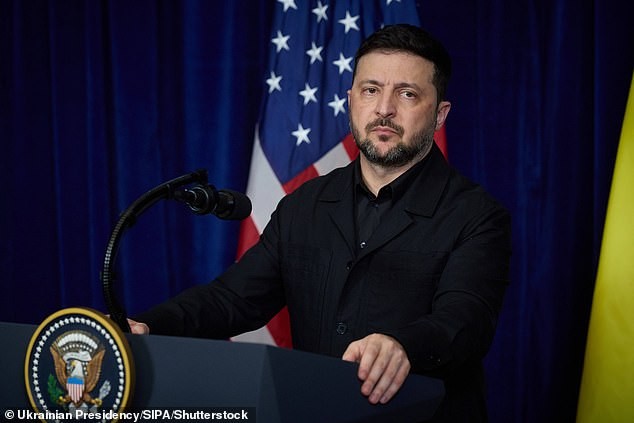
The United States and Ukraine were last night discussing the deployment of American troops to support the country as part of a peace deal. In a sensational turnaround, the White House appeared ready to put boots on the ground should Russia violate any negotiated settlement. The development was confirmed firstly by Polish prime minister Donald Tusk and later by Ukrainian president Volodymyr Zelensky. The US commitment is a huge boost to Ukraine and could prove significant in convincing the Kyiv government to end the conflict and even sacrifice territory in its eastern provinces. Last night, the duration of the US's security guarantees remained a sticking point. It has offered 15 years whereas Ukraine is pushing for significantly longer. The move is also a boost for Britain and France, to date the only countries to have agreed to send land forces to Ukraine if the fighting stops. The agreement will also put Vladimir Putin on the backfoot. The Russian dictator remains vehemently opposed to Western forces being stationed in Ukraine. The US commitment of ground troops comes after Russia claimed Ukraine attacked Putin's private residence in Novgorod. The development was confirmed firstly by Polish prime minister Donald Tusk and later by Ukrainian president Volodymyr Zelensky (pictured). But doubts have increased over Moscow's claim that 91 drones targeted the palace on the shores of the Black Sea. On Monday, Putin told Donald Trump about the incident, prompting the US President to condemn Ukraine. But since then the Kremlin has not produced evidence to substantiate its claims – which were dismissed by Ukraine as 'lies' intended to undermine peace efforts. Last night Mr Zelensky said he was ready to meet Putin in a bilateral summit. After a meeting of Nato leaders in Berlin yesterday, Polish leader Mr Tusk suggested the US was ready to engage militarily should Russia breach peace terms. He said: 'Peace is on the horizon, there is no doubt that things have happened that give grounds for hope that this war can end, and quite quickly, but it is still a hope, far from 100 per cent certain.' Mr Tusk cited US security guarantees for Kyiv as the prime reason that the conflict could come to an end, saying these could 'include the presence of American troops along the contact line between Ukraine and Russia' after a peace deal is reached. 'These fairly unambiguous declarations have appeared for the first time. We will see how consistent our partners on the other side of the Atlantic will be.'
In This Article:
White House signals possible ground troops to enforce peace
In a sensational turnaround, the White House appeared ready to put boots on the ground should Russia violate any negotiated settlement. The development was confirmed firstly by Polish prime minister Donald Tusk and later by Ukrainian president Volodymyr Zelensky. The US commitment is a huge boost to Ukraine and could prove significant in convincing the Kyiv government to end the conflict and even sacrifice territory in its eastern provinces. Last night, the duration of the US's security guarantees remained a sticking point. It has offered 15 years whereas Ukraine is pushing for significantly longer. The move is also a boost for Britain and France, to date the only countries to have agreed to send land forces to Ukraine if the fighting stops. The agreement will also put Vladimir Putin on the backfoot. The Russian dictator remains vehemently opposed to Western forces being stationed in Ukraine. The US commitment of ground troops comes after Russia claimed Ukraine attacked Putin's private residence in Novgorod. The development was confirmed firstly by Polish prime minister Donald Tusk and later by Ukrainian president Volodymyr Zelensky (pictured). But doubts have increased over Moscow's claim that 91 drones targeted the palace on the shores of the Black Sea. On Monday, Putin told Donald Trump about the incident, prompting the US President to condemn Ukraine. But since then the Kremlin has not produced evidence to substantiate its claims – which were dismissed by Ukraine as 'lies' intended to undermine peace efforts. Last night Mr Zelensky said he was ready to meet Putin in a bilateral summit. After a meeting of Nato leaders in Berlin yesterday, Polish leader Mr Tusk suggested the US was ready to engage militarily should Russia breach peace terms. He said: 'Peace is on the horizon, there is no doubt that things have happened that give grounds for hope that this war can end, and quite quickly, but it is still a hope, far from 100 per cent certain.' Mr Tusk cited US security guarantees for Kyiv as the prime reason that the conflict could come to an end, saying these could 'include the presence of American troops along the contact line between Ukraine and Russia' after a peace deal is reached. 'These fairly unambiguous declarations have appeared for the first time. We will see how consistent our partners on the other side of the Atlantic will be.'
Confirmations from Warsaw and Kyiv
The development was confirmed firstly by Polish prime minister Donald Tusk and later by Ukrainian president Volodymyr Zelensky. These confirmations add weight to the reported arrangement and underline the high-stakes diplomacy at play. The diplomatic lines opened by Poland and Kyiv mirror the mounting pressure on Moscow and the West to make a concrete and enforceable peace in Ukraine. The statements from both leaders, captured in the original reporting, anchor the story in real-time political maneuvering.
Security guarantees and the evolution of terms
Last night, the duration of the US's security guarantees remained a sticking point. It has offered 15 years whereas Ukraine is pushing for significantly longer. The article notes that the move is also a boost for Britain and France, to date the only countries to have agreed to send land forces to Ukraine if the fighting stops. The evolving security architecture is central to how a potential peace would be enforced and how long Western guarantees would endure.
Putin, drones, and the diplomatic standoff
The US commitment of ground troops comes after Russia claimed Ukraine attacked Putin's private residence in Novgorod. The development was confirmed firstly by Polish prime minister Donald Tusk and later by Ukrainian president Volodymyr Zelensky (pictured). But doubts have increased over Moscow's claim that 91 drones targeted the palace on the shores of the Black Sea. On Monday, Putin told Donald Trump about the incident, prompting the US President to condemn Ukraine. But since then the Kremlin has not produced evidence to substantiate its claims – which were dismissed by Ukraine as 'lies' intended to undermine peace efforts. Last night Mr Zelensky said he was ready to meet Putin in a bilateral summit.
A cautious optimism as peace talks inch forward
After a meeting of Nato leaders in Berlin yesterday, Polish leader Mr Tusk suggested the US was ready to engage militarily should Russia breach peace terms. He said: 'Peace is on the horizon, there is no doubt that things have happened that give grounds for hope that this war can end, and quite quickly, but it is still a hope, far from 100 per cent certain.' He also asserted that 'These fairly unambiguous declarations have appeared for the first time. We will see how consistent our partners on the other side of the Atlantic will be.' The cadence of these statements has framed a narrative of fragile optimism while underscoring the real risks that any peace would face from a resurgent conflict.