


Type 5 Diabetes Is Officially Recognized—Could Your Slim Teen Be At Risk?


Health authorities have officially recognized a new form of diabetes that targets young and slim people. The condition was first spotted in Jamaica in 1955, when 13 patients visited the clinic of Dr Philip Hugh-Jones and had signs of diabetes that did not match types 1 or 2. Dr Hugh-Jones called the condition 'type J,' but the label was quickly forgotten. It would be another three decades before the World Health Organization would classify it as 'malnutrition-related diabetes mellitus,' but the group dropped the label in 1999 due to a lack of evidence. Now, 70 years after it was first found, the International Diabetes Federation has given it a new name: type 5 diabetes.
In This Article:
A Long-Hidden Lineage: From Type J to Malnutrition-Related Diabetes Mellitus to Type 5
History reveals a long-hidden lineage. In Jamaica in 1955, 13 patients visited the clinic of Dr Philip Hugh-Jones and had signs of diabetes that did not match types 1 or 2. Dr Hugh-Jones labeled the condition 'type J,' but the name did not stick. It would be three decades before the World Health Organization would classify it as 'malnutrition-related diabetes mellitus,' a label the group dropped in 1999 due to a lack of evidence. Today, 70 years after the first cases, the International Diabetes Federation has given it a new name: type 5 diabetes.

Type 5 and the Global Diabetes Landscape
Diabetes occurs when the body either cannot produce enough insulin or use it effectively. Type 2 diabetes makes up nine in ten diabetes cases in the United States and is typically caused by obesity, poor diet and genetics. Type 2 diabetes affects nearly 600 million people worldwide and 38 million in the United States, while type 1, an autoimmune disease, strikes 9 million across the world and 2 million Americans. However, experts believe 25 million people across the world could be living with type 5 diabetes, most of whom don't know it and are slim teens and young adults living in low- and middle-income countries. This may also include people misdiagnosed as having type 1 diabetes. There are no specific estimates for the United States, and the American Diabetes Association (ADA) has not yet formally added it to its disease classifications. However, refugees, migrants and people with eating disorders may be at the highest risk due to their potential for malnutrition.
Symptoms, Underweight and Treatment Options
Symptoms of type 5 diabetes are largely similar to type 1, including increased thirst, frequent urination, headache, blurred vision, fatigue and slow-healing cuts and sores. These signs also overlap with classic symptoms of malnutrition such as weight loss, fatigue and hunger. According to the Mayo Clinic, people with the condition are typically underweight, meaning they have a body mass index (BMI) below 18.5. The average American has a BMI of 29, which is considered overweight and bordering on obese. Experts believe people with type 5 diabetes can produce insulin and are not resistant to it, but their pancreas is underdeveloped and cannot make enough due to malnourishment. Because of this, treating type 5 with insulin, like in type 1 or type 2, is often ineffective. Doctors are now investigating the effect of a high-protein diet rich in nutrients like zinc, B vitamins and magnesium to help patients gain weight and reduce glucose (blood sugar) spikes. Low-dose insulin may also be used but with caution.
New Research Sparks Global Call to Recognize Type 5
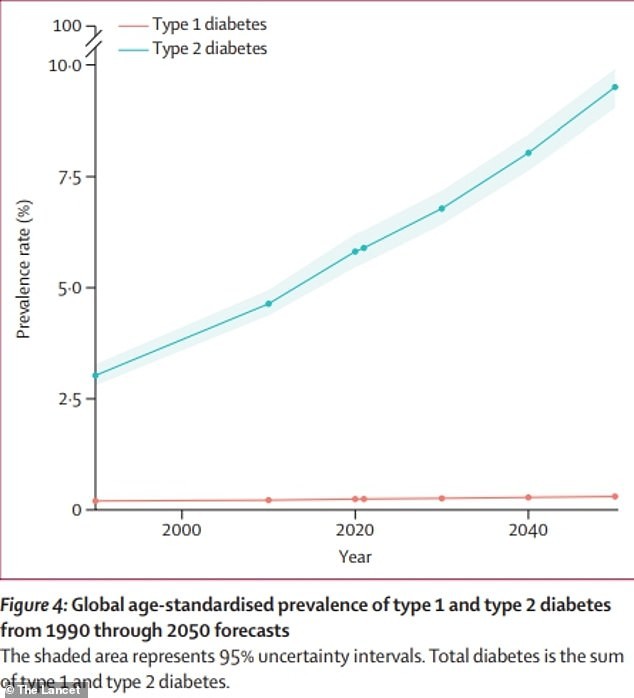
The above graph shows estimates for global diabetes cases. It is predicted that the number of people with the condition will more than double by the year 2050 compared to 2021. Earlier this year, a study published in The Lancet Diabetes & Endocrinology renewed interest in type 5 diabetes. Called the Young-Onset Diabetes in Sub-Saharan Africa (YODA) study, researchers sought nearly 900 young adults living in Cameroon, Uganda and South Africa who were diagnosed with type 1 diabetes. When the team took blood samples from the patients, they found roughly two in three participants lacked specific autoimmune markers seen in type 1 diabetes. Further testing also showed they still produced small but measurable amounts of insulin, unlike people with type 1 diabetes. However, those insulin levels were still below those seen in type 2 diabetes. The findings suggested the patients had a distinct type of diabetes, much like those Dr Hugh-Jones encountered in the 1950s. And writing in The Lancet Global Health a month later, a team of 50 researchers from 11 countries, including the US, concluded: 'We call upon the international diabetes community to recognize this distinct form of the disease. It likely affects the quality and length of life of millions of people worldwide. We encourage international organizations such as the International Diabetes Federation and World Health Organization (WHO) to promote more research into the phenotype, pathophysiology, and treatment of type 5 diabetes.' 'Misdiagnosis and underdiagnosis are likely to have negatively impacted the clinical care and lives of millions of individuals [with type 5 diabetes] worldwide.'