

The Bible Says Little About Jesus’ Childhood, Yet Medieval Christians Loved the Holy Rascal


Around Christmas, manger scenes typically show an ox and an ass beside the infant Jesus. According to the Gospel of Luke, Mary placed her child in a manger – an animal feeding bin – “because there was no room for them in the inn.” Far from mere babysitters, the ox and the donkey harken back to Isaiah 1:3, a verse early Christians read as a prophecy of Christ’s birth. In some early artworks, these beasts of burden kneel to show their reverence—recognizing this swaddled babe, who entered the world in humble circumstances, as lordly. The canonical Gospels—the accounts of Jesus’ life included in the Bible’s New Testament—make no mention of those animals welcoming the newborn. Yet the motif was already visible in art from the fourth century. It was further popularized by the Gospel of Pseudo-Matthew, an apocryphal text—that is, not part of the canon of Scripture. Pseudo-Matthew was composed by an anonymous monk, probably in the seventh century, and includes many tales about Jesus growing up. After its account of Jesus’ birth, the Bible is almost entirely silent on his childhood. Yet legends about Jesus’ early years circulated widely in the Middle Ages—the focus of my 2017 book. While the detail of the ox and the ass is quite familiar to many Christians today, few are aware of the other striking tales transmitted by the apocrypha.
In This Article:
From Manger to Reverence: Ox and Ass in Early Christian Art
The manger scene is not just decoration. It anchors a living argument about who Jesus is. The ox and the donkey are tied to prophecy and reverence. Mary places the infant in a manger “because there was no room for them in the inn,” and the animals’ presence signals a divine acknowledgment that a humble birth holds a cosmic significance. Early Christians linked this moment to Isaiah 1:3, and some fourth‑century images even show the beasts kneeling to acknowledge the newborn Lord. Through the centuries, the Gospel of Pseudo‑Matthew (a seventh‑century apocryphal text) helped popularize this motif by expanding tales about Jesus growing up. This opening motif sets the stage for a broader medieval appetite: if the Bible is quiet after Jesus’ birth, the apocrypha fills the silence with adventures, miracles, and moral tests that imagine a childhood far stranger and more powerful than the canonical accounts indicate.
Dragons, Palm Trees and Desert Journeys: The Miracles and Misrule of the Christ Child
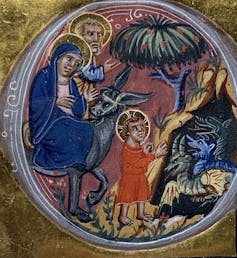
Like the adult Jesus of the New Testament, the apocryphal Christ child often works wonders to help others in need. Matthew’s Gospel recounts Mary and Joseph taking Jesus to Egypt after an angel warns in a dream that Herod, king of Judea, would kill the child. In Pseudo‑Matthew’s elaboration, Jesus, not yet 2 years old, stands bravely before dragons emanating from a cave where his family has halted to rest. The terrifying dragons worship him and then depart, while Jesus proclaims that he is the “perfect man” and can “tame every kind of wild beast.” He later commands a palm tree to bend down so that a weary Mary can partake of its fruits, and he miraculously shortens their journey in the desert. This body of legends paints a child who is at once divine and playfully human—the power to command nature paired with a boy’s knack for mischief.
Tring Tiles, Playmates and the Perilous Gifts of a ‘Wild’ Boy Jesus
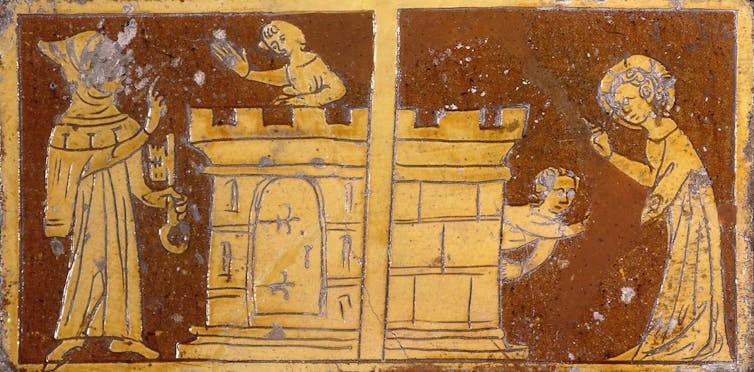
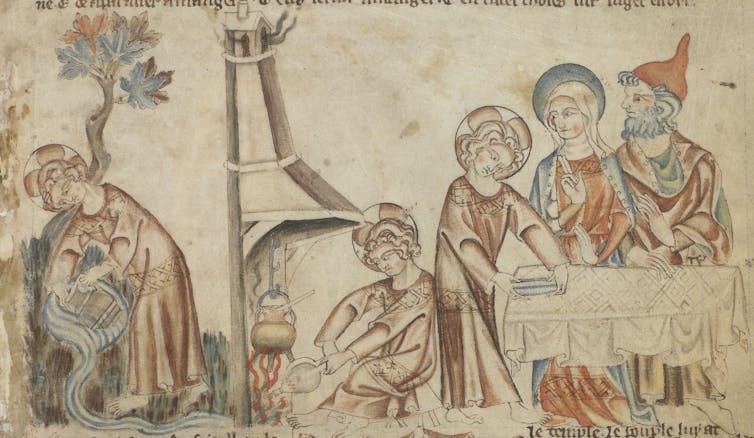
At times, these legends cast Jesus as a troublemaker who nonetheless attracts marvelous rescues. The 14th‑century Tring Tiles, now in the British Museum, depict one of Jesus’ friends imprisoned by his father in a tower. Christ pulls him out of a tiny hole, like a gallant medieval knight rescuing a maiden in distress. The father had strained to shield his son from Jesus’ influence—understandable, given that many legends show Jesus causing the death of his playmates or other boys who somehow irked him. In a story summarized by one scholar as “death for a bump,” a boy runs into Jesus. He curses the child, who instantly drops down dead—though Jesus brings him back to life after a brief reprimand from Joseph. In another tale, included in an Anglo‑Norman narrative surviving in an illustrated manuscript, Jesus takes off his coat, places it upon a sunbeam and sits upon it. When the other children see this, they “thought they would do the same …. But they were too eager, and they all fell down at once. One and another jumped up quickly onto the sunbeam, but it turned out badly for them, since each one broke his neck.” Jesus heals the boys at his parents’ prompting. Joseph admits to his neighbors that Jesus “was indeed too wild” and sends him away. The 7‑year‑old Jesus becomes apprenticed to a dyer, who gives him precise directions about dyeing three pieces of cloth in three different vats. Once his master has left, Jesus ignores the instructions, throwing all the cloth into one vat—yet still achieves the desired outcome. When the master returns, he first thinks he has been “ruined by this little rascal,” but then realizes that a wonder has occurred.