


Ten-Second Signal from the Dawn of the Universe 13 Billion Light-Years Away Shocks Scientists


A ten-second signal from one of the most distant points in the universe has been detected by humanity, and scientists are still trying to understand its origins. Two Earth satellites have confirmed that the mysterious signal came from a point 13 billion light-years away from Earth, which is approximately 1.23 × 10^23 kilometers. The light from such a distant event takes billions of years to reach us, so observing it is like looking back in time to the universe’s infancy. The high-energy gamma-ray burst, which researchers have named GRB 250314A, may be the earliest supernova ever recorded from the dawn of time. Gamma rays are invisible and ultra-powerful forms of light—the most energetic radiation known in the universe—produced by massive stellar explosions, and they appear as super-bright flashes from Earth. Scientists are still unsure why this ancient supernova looks almost exactly like the exploding stars we see in our nearby modern universe today. If this explosion is the true source of the signal, researchers from NASA and the European Space Agency (ESA) expect early stars to be bigger, hotter, and to produce much more volatile explosions than the mysterious signal suggested.
In This Article:
A 10-Second Gamma-Ray Burst from 13 Billion Light-Years Away
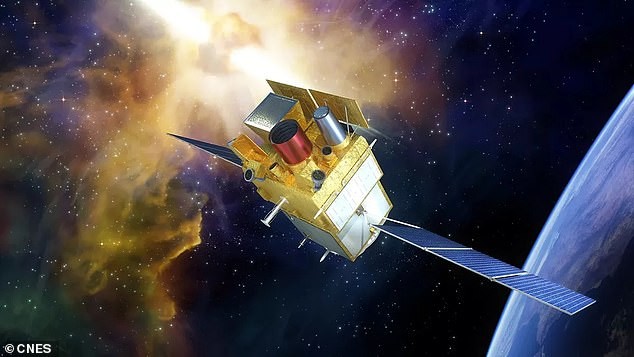
The signal was first discovered on March 14, 2025, when the Space Variable Objects Monitor (SVOM) satellite picked it up as a sudden flash of high-energy light from deep space. The burst lasted about ten seconds and is believed to originate from a gamma-ray burst from a star exploding about 13 billion light-years from Earth, with the gamma rays arriving weak enough to pose no danger to people on our planet. Two studies on the possible source of this distant signal have just been released. The SVOM probe is a joint project between scientists in France and China designed to spot these bursts throughout the cosmos. The signal scientists recorded was a short, powerful burst of gamma rays, invisible waves of energy stronger than X-rays and capable of passing straight through the human body, damaging cells, DNA, and tissues. The explosion’s distance means the gamma rays that reached Earth were far too weak to pose any danger. This burst lasted only about ten seconds because gamma-ray bursts are like quick fireworks in space, releasing a huge amount of energy in a very short time before fading away. Unlike random noise or background static in space, these gamma-ray bursts stand out as super-bright, focused beams with a distinctive pattern that satellites have been built to recognize. The burst has already left a fading glow that scientists can observe.
Gamma Rays What They Are and Why This Burst Matters
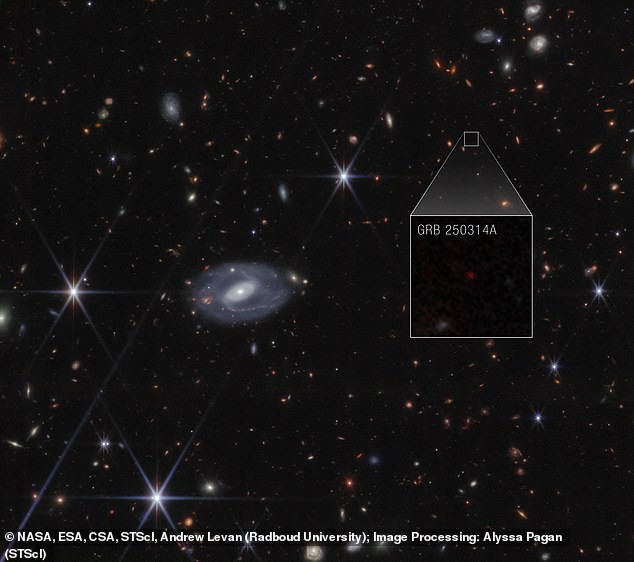
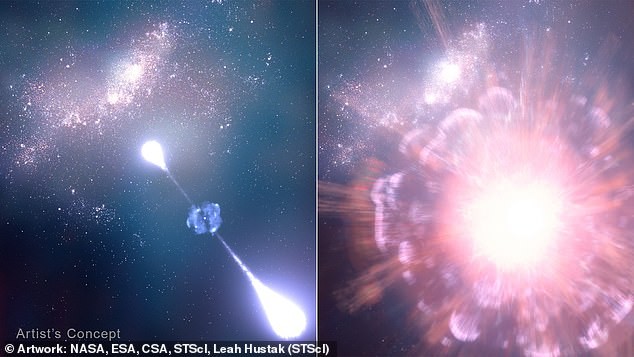
Gamma rays are invisible and ultra-powerful forms of light, and they are the most energetic source of radiation known in the universe, produced by massive stellar explosions. The bursts appear as super-bright flashes from our planet. Since this burst likely came from an exploding star 13 billion light-years away, the gamma rays that reached Earth were far too weak to pose any danger to people. Scientists note that this bursts’ energy is immense and that gamma-ray bursts are short-lived fireworks in the cosmos. The two Earth satellites concluded that the signal came from a distant region, and the burst’s brevity—lasting only about 10 seconds—reflects the nature of gamma-ray bursts as rapid, powerful events. The gamma-ray burst GRB 250314A (Pictured) is believed to be the source of a mysterious signal received from 13 billion light-years away. An artist’s impression of the supernova GRB 250314A as it was exploding during the first billion years after the Big Bang. NASA’s James Webb Space Telescope (JWST) confirmed the discovery about three and a half months later, by taking detailed pictures and measurements of the fading glow of the explosion, which could still be seen in space.
Webb Confirms the Story and What It Tells Us About the Early Universe
Only Webb could directly show that this light is from a supernova — a collapsing massive star, as Professor Andrew Levan of Radboud University in the Netherlands put it: 'There are only a handful of gamma-ray bursts in the last 50 years that have been detected in the first billion years of the universe. This particular event is very rare and very exciting.' The discovery underscored how a burst from 13 billion light-years away can illuminate conditions in the universe’s infancy. Other sources of mysterious space noise like solar flares or cosmic rays exist, but gamma-ray bursts are rarer and trace back to massive stellar explosions that scientists can track billions of years after they occur. Levan added that JWST is so advanced that scientists believe it will find more signals from when the universe was only five percent of its current age, roughly 14 billion years old now. To this point, scientists know very little about the first billion years of the universe, what was happening in space during this time, or how stars behaved and died. In December 2025, new studies published in Astronomy & Astrophysics analyzed detailed observations from the Webb Telescope and found that this supernova from 730 million years after the Big Bang had the same brightness and radiation signature as exploding stars billions of years later. Nial Tanvir, a professor at the University of Leicester in the UK, added: 'Webb showed that this supernova looks exactly like modern supernovae.' The research also included an artist’s impression of the event, illustrating the explosion during the first billion years after the Big Bang.