

Interstellar visitor 3I/ATLAS moves faster than human-made craft and is heading for Jupiter


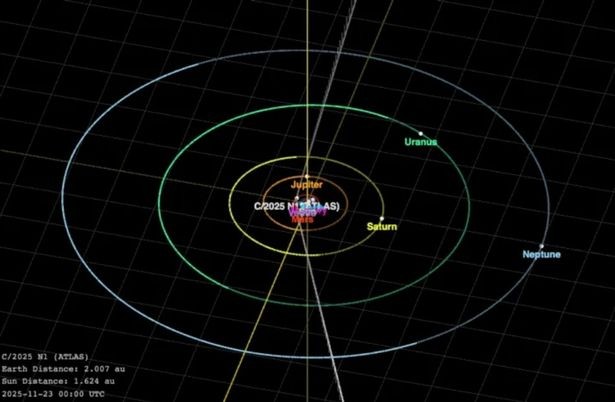
Scientists say the interstellar object 3I/ATLAS is moving so rapidly through the solar system that it will reach its next planetary target long before any human-made spacecraft can catch up. New data from the European Space Agency confirms the object is traveling “much faster than human-made spacecraft” and is already on course to reach Jupiter on a precise and rapidly approaching date. 3I/ATLAS reached perihelion on October 29, 2025, when it passed 202.9 million kilometres from the Sun. During that moment it was hidden behind the Sun from all Earth-based observatories, making direct observation nearly impossible.
In This Article:
First new look by Juice and data collection begins
Just a week later, however, ESA’s Jupiter Icy Moons Explorer, known as Juice, captured the first new look at the mysterious object as it swept past the spacecraft. Juice used five of its science instruments to study the visitor, collecting information on the composition and shape of the gas and dust plume surrounding 3I/ATLAS. Because the spacecraft is currently using its main high-gain antenna as a heat shield, it is unable to transmit data at full capacity. The scientific results will therefore not reach Earth until February 2026.

Juice images and close approach details
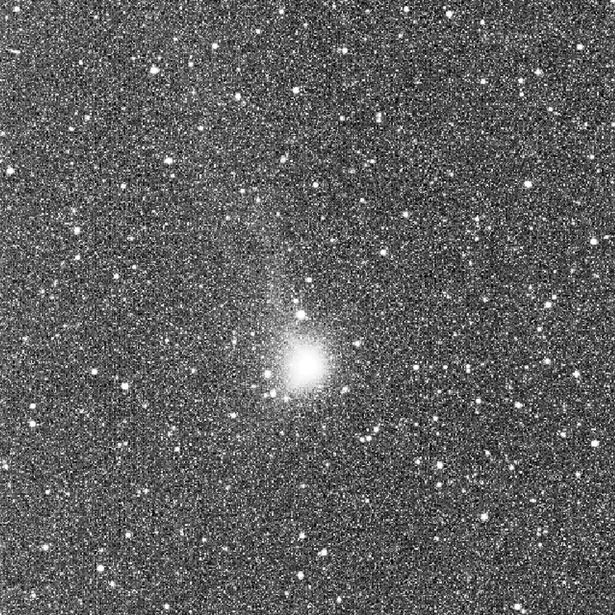
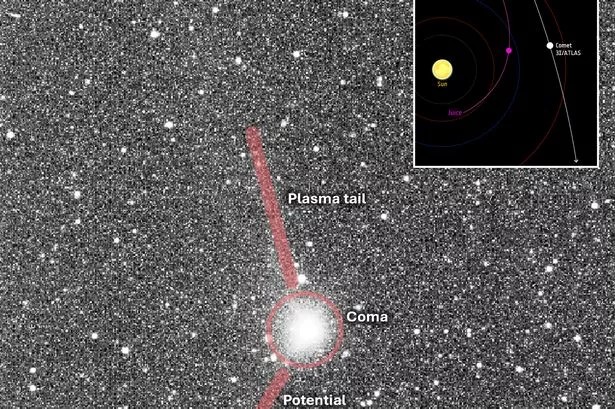
Juice photographed 3I/ATLAS using its onboard Navigation Camera, which will eventually guide the spacecraft through the Jovian system after it arrives at Jupiter in July 2031. ESA released a preliminary portion of the image, which was taken from just a quarter of a single NavCam frame. It shows a glowing halo of gas and dust surrounding the object, along with two faint tails extending behind it. The image was captured on November 2, 2025, during Juice’s first observation run. The spacecraft made its closest approach to 3I/ATLAS two days later, on November 4, at a distance of roughly 66 million kilometres.
Data release plans, expert analysis and outlook
The remaining scientific data is scheduled for release on February 18 and 20, 2026. The material will include high resolution images from Juice’s JANUS optical camera, spectrometry measurements from MAJIS and UVS, composition data from SWI, and particle readings from PEP. Researchers are now preparing for the next major milestone. “We all wait eagerly for the expected arrival of this data, a month before the closest approach of 3I/ATLAS to Jupiter on March 16, 2025,” astrophysicist Avi Loeb wrote in his analysis for Medium. Loeb noted that the timing highlights the extreme speed of the object, writing: “The fact that 3I/ATLAS will arrive at Jupiter in March 2026 whereas Juice will only get there in July 2031 after their rendezvous in November 2025, illustrates how much faster this interstellar visitor is compared to a human-made spacecraft.” Scientists expect more answers early next year as the newly gathered observations are decoded and released. For the latest breaking news and stories from across the globe from the Daily Star, sign up for our newsletters. 'Spaceship' 3I/Atlas causes panic as world leaders activate 'space defences' in secret Stunning women forced to hire 'husbands for an hour' as country has man shortage