


Interstellar Object 3I/ATLAS Closes In on Earth as Its Heartbeat Sparks Debate


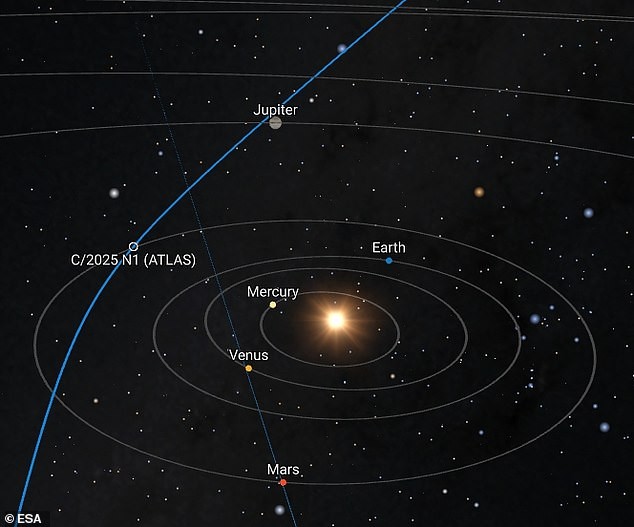
An enigmatic visitor from another star system is hours away from its closest approach to Earth. On December 19, 3I/ATLAS is projected to come within about 274 million kilometers of our planet, close enough to be seen with small telescopes or cameras but still far enough to pose no threat of collision. NASA has said there is no evidence pointing to the object being artificially constructed or harboring extraterrestrial life, concluding that it is a large space rock from a distant solar system. Researchers warn that 3I/ATLAS is not acting like a normal comet, a caution echoed as the clock ticks toward its closest approach.
In This Article:
Closest Approach to Earth Confirmed at 274 Million Kilometers
3I/ATLAS is projected to reach its closest point to Earth on Friday, December 19, when it comes within about 274 million kilometers of the planet. NASA has stated that there is no evidence pointing to the object being artificially constructed or harboring extraterrestrial life, concluding that it’s a large space rock from a distant solar system. On November 19, administrators from NASA held a press conference where they declared 3I/ATLAS a comet and reported that the agency hadn’t detected any technosignatures, technological traces of intelligent life.
Heartbeat Rhythm and Ancient Timings
Independent researcher and author Andrew Collins has shown evidence that a mysterious 'heartbeat' emanating from the object pulsed in a 15.48-hour cycle that strangely aligned with Earth's 24-hour day.\nScans this summer previously showed that it had been blasting out in rhythmic bursts every 16.16 hours precisely, but new data from Spain's Two-meter Twin Telescope in September found this number had changed slightly as it neared Earth.\nIt's unclear if something within 3I/ATLAS physically changed or if scientists have just gathered more precise measurements, but Collins noted that the strange pulsations line up perfectly with timing systems used by the ancient Chinese and Indians.\nDoes intelligent life exist beyond earth?\nHe broke down the comet's pulses of brightness and found that the new 15.48-hour cycle fit into exactly 387 of these units, while Earth's full 24-hour day fits precisely into 600, which Collins said was too perfect to be a coincidence.\nCollins suggested this sync might mean the comet has been 'broadcasting' a universal math pattern, hinting at intelligent design rather than random chance, and tying our planet's spin to age-old ideas of cosmic rhythms.
Loeb, DNA Clues and the Directed Comet Debate
In the new paper, Collins referenced the work of Avi Loeb, the head of the Galileo Project, a research group looking for extraterrestrial life, who has been studying this heartbeat and a dozen other strange clues tied to the alleged comet. One of those was the object ejecting particles of DNA building blocks, such as methanol and hydrogen cyanide, which Loeb has hypothesized could mean 3I/ATLAS has been seeding nearby planets like Mars, Venus, and Jupiter with life.\nLoeb has documented near-impossible paths and the object speeding up strangely without the help of gravity, and 3I/ATLAS appearing to come from the same direction as the famous 1977 'Wow! Signal.'\n'The many anomalies associated with 3I/ATLAS strongly hint that it is not a mundane comet but what might be described as a directed comet,' Collins said in his paper submitted to ResearchGate.\nCollins explained that if 3I/ATLAS were a 'directed comet,' it could be an intelligent form of life that 'wakes up' in star systems, using a super-hot gas called plasma to think and act.
Public Viewing and Official Skepticism
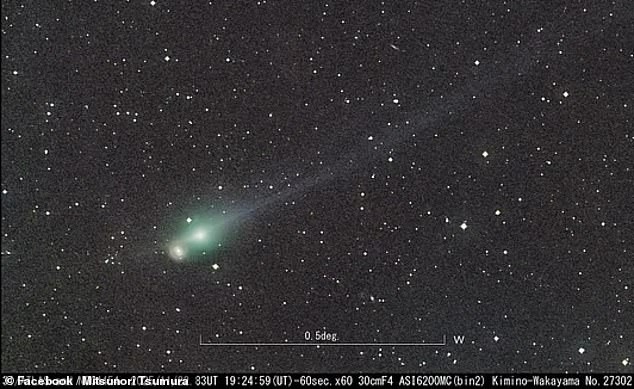
Both NASA and the European Space Agency (ESA) have dismissed any theories that 3I/ATLAS is anything more than a lifeless comet with a unique chemical mixture created by its home solar system. Yet, Loeb recently appeared on The Danny Jones Podcast and slammed NASA for failing to consider all of the possibilities surrounding 3I/ATLAS as it nears Earth tomorrow.\nLoeb has focused heavily on the object's massive size and so-called 'anti-tail,' a stream of particles pointing at the sun instead of away from it like a normal comet's tail — which Loeb has suggested could be a sign of a spacecraft's engine.\n'How do you explain the large mass of the object quantitatively, not just say "oh, comets are weird and some of them are unusual and therefore it's okay." That's not an explanation,' Loeb said.\n'You can't just be a bureaucrat who makes statements, and everyone should believe you because of your authority. That's not the way science is done.'\nColor-enhanced images shared by multiple social media users revealed 3I/ATLAS developed a strange green glow as it neared Mars and the sun in October.\n'You can't ignore it. This is not politics, we are talking about science here,' he continued during the December 8 podcast.\nNASA has also been slammed for an October press conference, which released low-quality images of 3I/ATLAS despite the space agency's Mars space probes coming within 29 million kilometers of the object.\nThe public will have its best chance to view 3I/ATLAS using telescopes with a lens as small as five inches starting tonight at 11pm ET. Viewers should focus on looking east to northeast. During the early pre-dawn hours on Friday, the object should appear right under Regulus, a star at the heart of the constellation Leo.