


China Goes All In on Copying SpaceX Starship and Sparks Global Space Rivalry


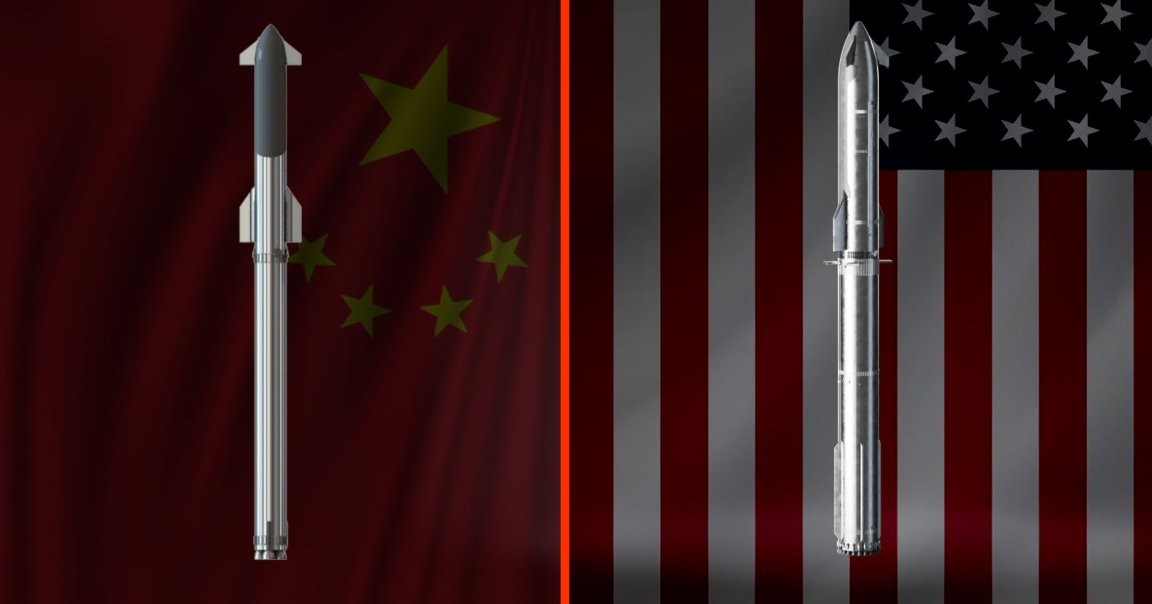
SpaceX’s Falcon 9 rocket ushered in a new era, offering a fully reusable launch platform that brought outer space closer than ever by dramatically lowering the costs of sending payloads — and eventually astronauts — into orbit. Now Elon Musk’s space corporation has even more to prove when it comes to its Starship, a gargantuan super heavy lift rocket and booster duo that’s still deep in the development phase. Following over a dozen major explosions, the rocket has yet to safely launch and return to the ground in one piece. That hasn’t dissuaded a growing number of Chinese companies from unabashedly ripping off the concept, as Ars Technica reports. “Very early stage, only conceptual claims, very ambitiously aiming for 2027 debut fight,” journalist Andrew Jones tweeted. “Wild.”
In This Article:
Beijing Leading Rocket Technology’s Xingzhou-1 Echoes Starship in Look and Name
Most recently, state-operated news outlet China.com detailed a company called “Beijing Leading Rocket Technology” that named its latest vehicle concept Xingzhou-1 — which translates to “Starship-1” or “Starvessel-1.” A render of the rocket closely resembles SpaceX’s design as well, from the overall proportions down to the grid fins designed to guide the Super Heavy booster and Starship spacecraft back down to the ground.
Cosmoleap and Astronstone Join the Copycat Parade
Several other Chinese startups have similarly proposed rocket designs that rip off SpaceX’s Starship, from Cosmoleap, which painstakingly recreated the concept down to a render of a Super Heavy booster-like rocket being caught by a launch tower by two extremely familiar-looking 'chopstick' arms. A separate firm, called Astronstone, also said it was looking to recreate the concept, “fully aligning its technical approach with Elon Musk’s SpaceX,” albeit at a smaller scale.
China’s Official Reusable Concepts Mirror Starship
Even a heavy lift rocket China’s national space officials showed off a year ago bore a striking resemblance to Starship, from a “two-stage, fully reusable configuration” right down to the aerodynamic flaps.
Reality Check: Zhuque-3 and SpaceX’s Ongoing Struggle
Case in point, earlier this month, private Chinese space company LandScape attempted to launch and land its reusable and Falcon 9-like Zhuque-3 rocket booster, only for it to explode during its first orbital test. Even SpaceX itself is struggling to turn its mammoth Starship into a reliable platform that can send up to 150 metric tons to space in a single launch — which isn’t exactly surprising, given the project’s unprecedented scale. Where that leaves far smaller Chinese companies vying for investor attention to cash in on Musk’s Moonshot idea remains unclear at best.
NASA and Public Skepticism About the Moonshot
NASA’s interim administrator Sean Duffy telling Fox News earlier this year that it’s looking for alternatives, arguing that SpaceX is behind schedule for the mission, which is tentatively scheduled for 2027. “Until they make a reliable and working full-flow engine, all these copy efforts won’t be worth diddly squat,” one Reddit user wrote. “But will look neat and sometimes explode with a lot of fireworks!” “I wish they would mimic our free speech like they mimic our technology,” another user added facetiously.
About the Author
I’m a senior editor at Futurism, where I edit and write about NASA and the private space sector, as well as topics ranging from SETI and artificial intelligence to tech and medical policy.