


Atlas Unleashed on Stage The 360 Degree Humanoid That Feels Unsettlingly Real


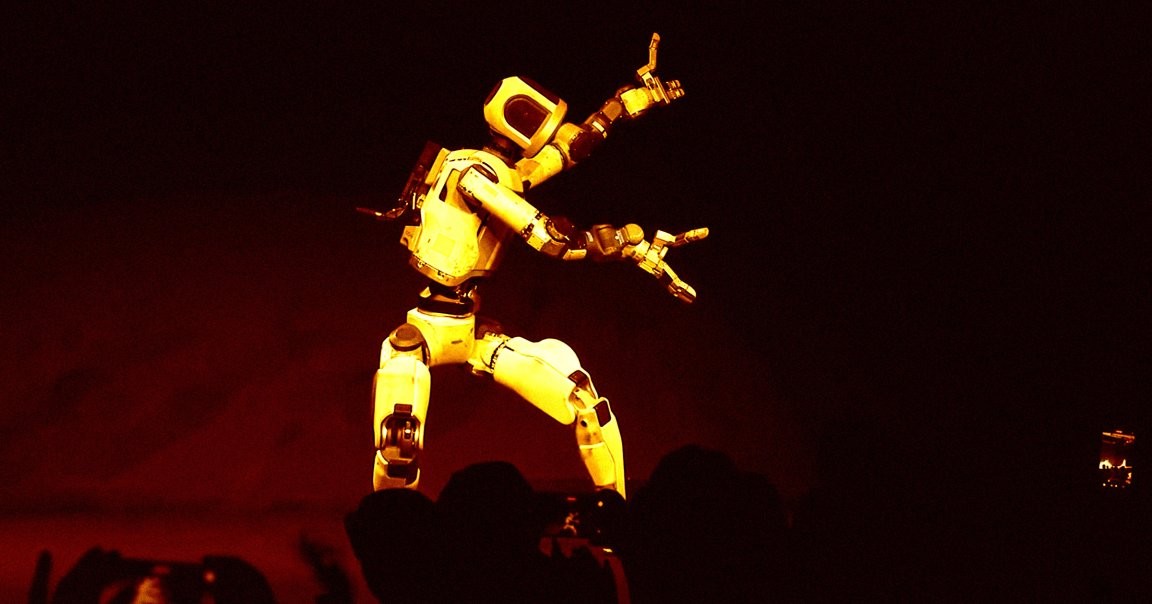
Not everybody agrees that replicating the four-limbed, bipedal shape of a human should be replicated in robot form. For one, walking with two feet is inherently less stable than four, nevermind a set of wheels. Replicating the dexterity and fine motor skills of human hands also remains a major challenge. In a modified approach, Boston Dynamics has clearly decided to loosen up some of the restrictions of the human form. During an on-stage demonstration at this year’s CES convention in Las Vegas, Boston Dynamics showed off the agility of its humanoid Atlas robot — albeit with an unnerving degree of freedom of movement that dispels the illusion of a human entity. Key to the demo is that the robot features clever joints that allow for “continuous rotation.” In effect, its hips, wrists, and neck can swivel a full 360 degrees unimpeded. After confidently strutting to the front of the stage, Atlas starts twisting its hands like a drill, rotating its head like the girl in “The Exorcist,” and even turning its entire torso around in a dizzying maneuver — a clear indication that Boston Dynamics isn’t planning to be boxed in by the limitations of human anatomy. “There’s more to it than just copying nature,” Boston Dynamics CEO Robert Playter said during the announcement. “We can pick the best parts of what nature has to offer and do better in others.”
In This Article:
The Production Ready Atlas and Its AI Alliance
The demo was part of Boston Dynamics’ announcement of a production-ready version of its Atlas robot. The Hyundai-owned firm also announced a partnership with Google’s DeepMind to bring AI smarts to its bots as well. The firm claimed that it’s already working on a robot that can be deployed in a car factory. The plan is to deploy it at Hyundai’s EV manufacturing facility by 2028. The robot stands about 1.88 meters tall and weighs roughly 91 kilograms. However, pricing and an availability date for the six-foot-two, 200-pound robot have yet to be revealed. Beyond spinning its head and hands around freely, Boston Dynamics has shown how Atlas can manipulate car parts and even perform slick breakdancing moves. “Atlas is going to revolutionize the way industry works, and it marks the first step toward a long-term goal we have dreamed about since we were children,” Playter boasted on stage.
The Big Questions About Atlas Costs Viability and Use Cases
Yet many questions remain about the tech’s long-term viability. For one, not everybody agrees that they make the most sense when it comes to actually replacing human labor. Experts have also warned that humanoid robots could be the next financial bubble. When or if bipedal robots will be the form factor of choice, particularly when it comes to industrial settings, remains a subject of debate. “I think the question comes back to what are the use cases and where is the applicability of the technology,” McKinsey partner Alex Panas told NBC News. “In some cases, it may look more humanoid. In some cases, it may not.”
Verdict on Liberty and Practicality
Judging by its latest demo, Boston Dynamics is playing it safe by taking some liberties. I’m a senior editor at Futurism, where I edit and write about NASA and the private space sector, as well as topics ranging from SETI and artificial intelligence to tech and medical policy.