


Archaeologists Uncover an Ancient Basalt Tablet with an Unknown Language


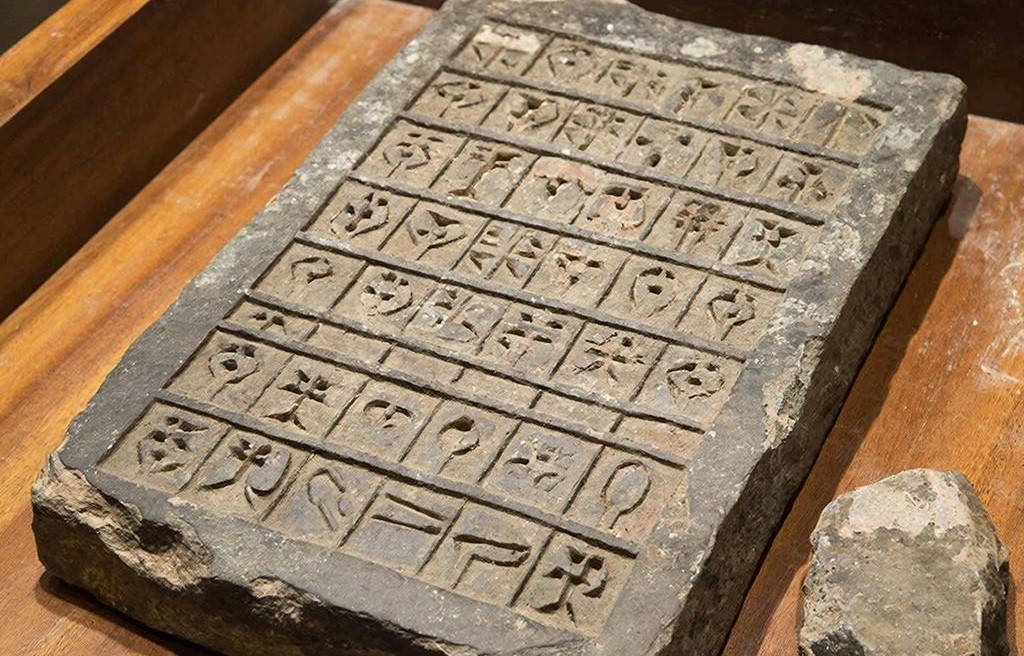
Recently, archaeologists found a basalt tablet about the size of a sheet of paper, on which unusual symbols are clearly visible, according to Popular Mechanics. The artifact was discovered near Lake Bashplemi (Georgia), a region famous for its archaeological discoveries, among which are remains of hominids dating to about 1.8 million years ago. The study results were published in the Journal of Ancient History and Archaeology. Photo from open sources / Illustrative image created by AI.
In This Article:
- A Basalt Tablet Roughly the Size of a Sheet of Paper
- Inscriptions Show High Craftsmanship Despite an Unknown Script
- Borrowings and a Possible New Language
- Closest Written Traditions Are Ancient Proto-Cartvelian Languages
- The Find Itself Is of Great Archaeological Interest
- The Craft of the Inscriptions and What It Implies
- Possible Contents of the Text
A Basalt Tablet Roughly the Size of a Sheet of Paper
The tablet, made from local volcanic stone, contains on its surface seven rows of symbols, totaling 60 signs, among which there are numbers and punctuation marks. Although the material of the tablet is well studied and local, the meaning of the engraved symbols remains a complete mystery.
Inscriptions Show High Craftsmanship Despite an Unknown Script
According to researchers, the inscriptions demonstrate signs of high craftsmanship, even though the writing system itself remains unclear to specialists. The initial comparison with more than twenty known languages showed some similarity with Semitic, Brahmanic and North Iberian writing systems, but none of the known forms exactly match the signs found.
Borrowings and a Possible New Language
Some specialists suppose that individual elements could have been borrowed from early Caucasian alphabets, such as Georgian Mrglovani or Albanian letters, as well as proto-Cartvelian, Phoenician and early Egyptian writing systems. However the absence of clear parallels with any other writing forms leads scientists to suppose that this is a completely new, hitherto unknown language.
Closest Written Traditions Are Ancient Proto-Cartvelian Languages
Researchers believe that the closest in writing are ancient proto-Cartvelian languages of the fourth millennium BCE, used in the territory of Georgia and Iberia. Nevertheless, many signs resemble Bronze Age glyphs of the region, showing connections with Greek, Phoenician and even early Arabic writing.
The Find Itself Is of Great Archaeological Interest
The place of discovery itself presents great interest for archaeology, since Lake Bashplemi is known for a number of significant historical artifacts.
The Craft of the Inscriptions and What It Implies
The process of making the inscriptions is also impressive: researchers suppose that the craftsman used a conical tool to draw the outlines of each sign, and then finished the work with a tool with a smooth rounded head. This indicates a high level of development of technologies in this region in ancient times.
Possible Contents of the Text
Although the interpretation of the symbol meanings is ambiguous, the authors of the study suggested possible contents: military trophies, important construction projects or religious dedications to gods.